Into the white heat of technology

Updated: Dec 11, 2025
In 1963, Harold Wilson told the British public that to emerge from the dour struggles of post-war Britain and move into a modern age, it must embrace the ‘white heat of technology’.
His speech imagined how new technologies like the television would create a ‘University of the Air’, which became the Open University, to diffuse intelligence across the economy at a speed never dreamed possible before. This he argued, was the key to the growth and improved living standards the country craved.
If the promise of that technology for society seemed at the time like a white heat, the fresh promise of the more rapid dispersion of intelligence that we have today with the advent of artificial intelligence feels hotter than the core of the sun.
Indeed, sat in the United Kingdom, as our leaders battle with the pervasive sense of a country in economic decline, it is perhaps strange that we enter 2026 with such frustrations but also with such high hopes for the transformation the world economy can see in the years ahead.
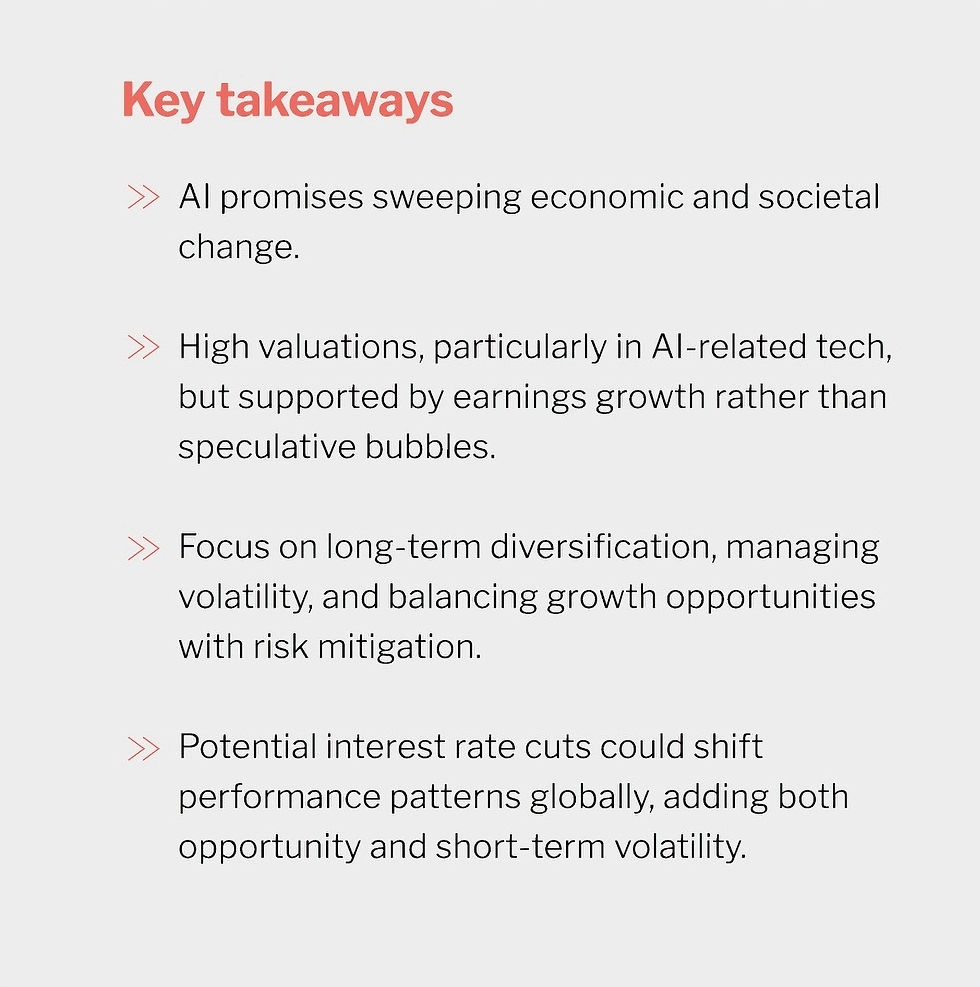
Artificial intelligence promises productivity gains on an extraordinary scale, with exponentially faster progress across industry, medicine and society.
We could see 2025 as the year that stock markets fully embraced this possibility and made the biggest bet in stock market history to back the idea that artificial intelligence will transform the world. We saw the value of technology companies rise massively to the point where the world’s leading chip maker Nvidia, now has a larger market capitalisation than the whole of Japan.
This inevitably means we enter 2026 with some concern about stock market valuations.
There is no doubt that they are priced more highly than average, and this could well result in some turbulence in 2026. Yet the strong earnings growth that the most successful companies have seen means that the valuations of these companies have not entered the sort of ‘bubble’ territory that some fear.
The US market, measured by the S&P 500, is currently trading on a price-to-earnings ratio of 22.8 times. This compares to an average over the past 10 years of 18.72 times. The world stock market, measured by the MSCI World index, is trading on 20 times its earnings, compared to a ten-year average of 17 times (Source: Bloomberg at 26.11.2025). We must acknowledge that stock markets enter 2026 looking a bit expensive. But also that relatively normal levels of earnings growth in the coming three years would justify these companies moving back to about average valuations. Or to put it another way, a relatively modest pullback in the stock market, perhaps of the order of 10%, would make these markets look fairly valued.
We take no pleasure in those times when stock markets fall in value, but we must also acknowledge that peaks and troughs of this order of magnitude are a normal part of investing, like turbulence on a flight. The key lesson is to remain invested rather than overreact to such corrections.
It is true of course, that the largest US technology companies are trading on much higher valuations, north of 30 times their earnings. They have a mountain to climb to justify their earnings. Yet so far, they are climbing fast, and the data tells us that whatever scepticism we may feel, the market continues to bet that the white heat of artificial intelligence will provide the spur to deliver on the hoped for earnings numbers.
We also take comfort that there are broader economic forces that can come into play next year to enable parts of the world stock market that have not kept up with the artificial intelligence boom to start to catch up.
Markets are forecasting interest rate cuts across the rich world in the early part of 2026. This offers the potential for improved performance from parts of the global stock market that have been less immediately lifted by the growth of artificial intelligence. The current market forecast is that the US Federal Reserve will set the pace for the world with interest rate cuts in both December and January. We should expect that as these expectations move around, it will produce some stock market volatility.
Ultimately, the cuts will be welcome. Maintaining strong allocations to technology companies has been the right decision for portfolios in recent years, but our philosophy is always to pursue the maximum diversification and resilience we can achieve for clients, and we will be actively exploring how to diversify away from these areas as other opportunities crystallise throughout 2026.

